

Skill Inflation: Why Being Average Is Becoming Professionally Dangerous
In an AI-accelerated world, average skills are no longer enough. Discover why skill inflation is rising and how verified proof not just skill acquisition creates real professional advantage.
aadityakasaudhan2002@gmail.com
16 Feb 2026
3 min read
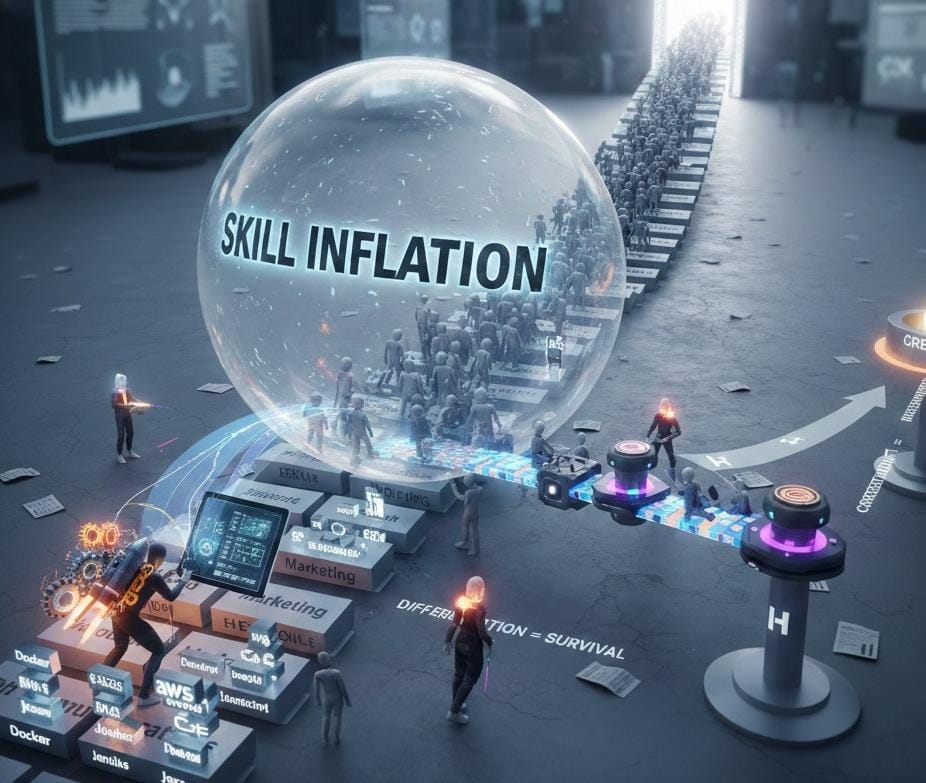
Skill Inflation: Why Being “Average” Is Becoming Professionally Dangerous
There was a time when being average was safe. Get a degree, learn a basic skill, land a stable job, stay consistent, grow slowly. That formula worked for years. But that world doesn’t exist anymore.
Today, skills are multiplying at an aggressive pace. Tools are evolving faster than ever. AI is accelerating production. Barriers to entry are collapsing. And when everyone has access to the same tools, the baseline automatically rises. What used to be impressive is now simply expected. Basic coding is common. Basic design is everywhere. Basic marketing is automated. Basic communication is a standard requirement. The skillset that once secured opportunity is now just the minimum entry ticket.
This is skill inflation — and it’s accelerating.
Just like economic inflation reduces purchasing power, skill inflation reduces professional value. When more people can perform the same task at the same level, the market stops rewarding it. Average becomes invisible, and invisible professionals get overlooked.
The real danger is subtle. Most people don’t feel behind. They feel comfortable. They understand their role. They complete their tasks. They meet expectations. But in a competitive ecosystem, meeting expectations isn’t growth — it’s maintenance. And maintenance doesn’t create leverage.
High performers understand something critical: when the baseline rises, differentiation becomes survival. It’s no longer enough to simply know a skill. You must apply it at a higher level. You must combine it with other capabilities. You must demonstrate it through outcomes. You must evolve faster than the average curve.
Because employers aren’t just asking, “Can you do the job?” They’re asking, “Can you outperform the norm?”
AI has amplified this shift. Tasks that were once valuable because they required effort are now automated. Writing drafts, creating designs, running reports, generating analysis — all of it can be assisted or replaced. When effort becomes automated, judgment becomes valuable. When execution becomes common, strategic thinking becomes rare. And when skills become common, credibility becomes the true differentiator.
This is where most professionals miscalculate. They focus on acquiring more skills, collecting certifications, and stacking courses. But in an inflated market, acquisition alone doesn’t create value. Proof does.
The professionals who win in a skill-inflated world aren’t the ones endlessly collecting credentials. They’re the ones building visible outcomes. They show projects. They document measurable impact. They demonstrate growth over time. They don’t just say they learned something — they show what they built with it.
Because when skills are everywhere, proof becomes premium.
This isn’t about fear. It’s about awareness.
If you remain average in an accelerating environment, the gap doesn’t stay small. It widens quietly and gradually until you realize you’re replaceable. And replaceable professionals don’t control opportunity. They wait for it.
The new advantage isn’t just learning fast. It’s evolving visibly.
And that’s where Honour naturally fits into this shift.
In a world where everyone claims skills, Honour helps professionals convert learning into verified credibility. Instead of simply listing capabilities, you validate them. Instead of saying you improved, you document it. Instead of blending into a crowd of similar profiles, you build a trust-backed professional signal.
Honour turns your skill growth into proof. Your projects become traceable. Your contributions become visible. Your consistency becomes measurable over time.
In a skill-inflated economy, that visibility matters. Because when average becomes crowded, verified performance becomes scarce — and scarcity creates advantage.
The future doesn’t belong to the most comfortable professionals. It belongs to the most adaptive.
And in an era of rising standards, being average isn’t safe anymore. It’s risky.
Related Posts

Featured
You Are Not Behind in Life. You Are Just Comparing Your Chapter 2 to Someone Else’s Chapter 20.
Feeling late in life is often just a comparison trap. You’re not behind, you’re comparing different timelines. Here’s how to break the illusion and build real proof of progress with Honour.
05 Mar 2026
3 min

Featured
Your Network Doesn’t Create Opportunities. Your Value Does.
Networking helps, but it doesn’t replace value. Discover why building undeniable skill and proof matters more than collecting contacts.
26 Feb 2026
3 min

Featured
Skill Is Not Enough Anymore: What Actually Gets You Hired and Trusted
Skills matter, but they don’t stand out the way they used to. In a world of inflated resumes and AI-generated profiles, credibility comes from proof, consistency, and trust. Here’s what actually moves careers now.
22 Feb 2026
3 min